No. 3The Berlin Wall3 of 5 issues

WaybackWire

The news as it was reported

The Berlin WallThursday, November 9, 1989Issue the Third

East Germany drops travel restrictions

thousands go to the Wall

East Germany said tonight its citizens may leave through every border crossing, including into West Berlin. By late evening about 1,000 had crossed at Bornholmer Strasse, while at Checkpoint Charlie East Berliners were told to wait until Friday.
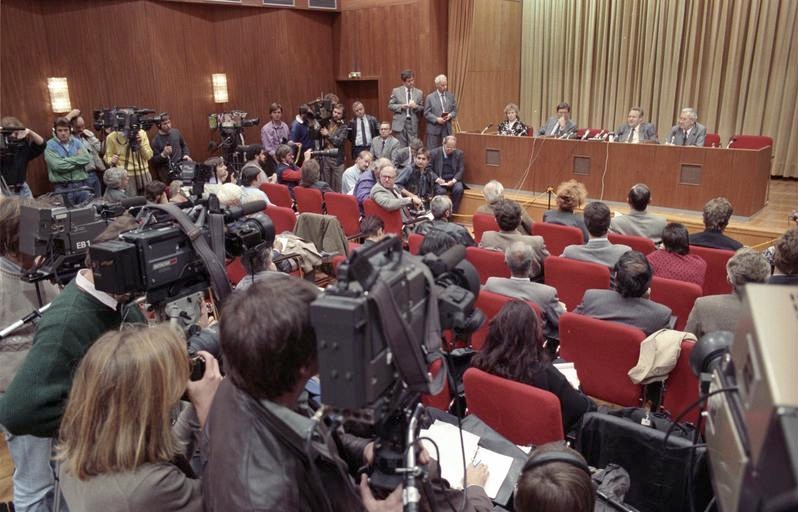
Politburo member Guenter Schabowski answers questions from East German and foreign journalists at the International Press Center in East Berlin on Thursday, after the second day of the Central Committee meeting.
Politburo member Guenter Schabowski answers questions from East German and foreign journalists at the International Press Center in East Berlin on Thursday, after the second day of the Central Committee meeting.Photograph by Thomas Lehmann, Nov. 9, 1989 · CC BY-SA 3.0 de

EAST BERLIN, Thursday.—East Germany said tonight that its citizens may leave through every border crossing, including those into West Berlin, and thousands went to the Wall.

“Permanent trips out of the country can be made through all border crossing points of the German Democratic Republic to the Federal Republic of Germany or to West Berlin,” the government announcement said.

Politburo member Guenter Schabowski read out the new rules at a televised press conference in East Berlin. Applications for private travel abroad no longer need a stated reason or proof of family ties, he said.

Permanent trips out of the country can be made through all border crossing points of the German Democratic Republic to the Federal Republic of Germany or to West BerlinEast German government announcement

How the rules will work at the Wall itself is far from clear tonight. Schabowski said the checkpoints would remain until Parliament passes a new travel law, and that police had been told to issue visas immediately.

An estimated 1,000 people crossed at the Bornholmer Strasse checkpoint, and cars were waved through at Invaliden Strasse late in the evening.

“One couple ran toward me, and as soon as they crossed the white demarcation line into West Berlin, they flung their arms around my neck and the three of us wept for joy,” said a 45-year-old West Berlin man in a blue tracksuit at the Bornholmer checkpoint.

At Checkpoint Charlie the picture was different. Guards there told East Berliners they would not be let through until the new regulations took effect on Friday, and then only with visas stamped in their passports.

Schabowski said the ruling did not mean the Wall would be torn down.

West Berlin’s Governing Mayor, Walter Momper, said: “We have waited 28 years for this.”

The announcement capped a week of upheaval in East Germany. The Cabinet resigned on Tuesday and the Politburo was reshaped on Wednesday.

Authorities. United Press International · Cold War International History Project (CWIHP) via 1989.rrchnm.org; all Nov. 9, 1989.

Schabowski says new travel rules apply ‘immediately’

EAST BERLIN, Thursday.—The news came in a live, televised press conference that ran from 6:53 to 7:01 p.m. at the International Press Center in East Berlin. Guenter Schabowski, the Politburo member who speaks for the party, read from a paper.

“Applications for travel abroad by private individuals can now be made without the previously existing requirements,” he read. “Permanent exit is possible via all GDR border crossings to the FRG.” Asked about West Berlin, he read that permanent exit could also take place through the crossings into West Berlin.

A reporter asked when the rules took effect. “That comes into effect, according to my information, immediately, without delay,” Schabowski said.

Applications for travel abroad by private individuals can now be made without the previously existing requirementsGuenter Schabowski

At the same table, an official named Beil said quietly: “That has to be decided by the Council of Ministers.”

Asked what would become of the Berlin Wall, he said the question of crossing it from the East German side had not been answered yet.

Quotations are from the Cold War International History Project’s English translation of the television broadcast.

Authorities. Cold War International History Project (CWIHP) via 1989.rrchnm.org, Nov. 9, 1989.

West’s camps fill as writer begs East Germans to stay

BONN, Thursday.—West Germany is struggling to house the stream of East Germans arriving in the West, and in the East a leading writer went on television to beg them to stay.

Between 200 and 300 East Germans an hour have crossed into West Germany since Saturday, United Press International reported from Bonn, putting the total since August at more than 120,000.

Border police and the Red Cross have set up 140 reception camps, and many are filling beyond capacity.

there is free refugee movement. That is the problemHerbert Schmalstieg, mayor of Hannover

Bremen has decided not to accept new refugees. Herbert Schmalstieg, the Social Democratic mayor of Hannover, said other cities would follow.

Schmalstieg, who is also vice president of the association of West German mayors, said “there is free refugee movement. That is the problem.”

In East Berlin, the writer Christa Wolf read a statement on East German television signed by several leaders of the opposition movement. “We beg you, stay in your homeland, stay with us,” she read.

Authorities. United Press International · United Press International; all Nov. 9, 1989.

Bonn parliament breaks off its session for the news

BONN, Thursday.—The West German parliament interrupted its evening session tonight from 8:22 to 8:46 p.m. When it resumed, the government made a short statement on the East German decision.

Rudolf Seiters, the minister in charge of the Chancellery, said he had just spoken to Chancellor Helmut Kohl by telephone. He called the provisional freeing of visits and exits from East Germany “ein Schritt von überragender Bedeutung” (our translation: “a step of overriding importance”).

He repeated Kohl’s offer of help, made on Wednesday, on condition that the ruling Socialist Unity Party gives up its monopoly of power.

ein Schritt von überragender BedeutungRudolf Seiters, head of the Chancellery (German original; our translation: "a step of overriding importance")

Hans-Jochen Vogel, the Social Democratic leader, welcomed the decision but said the details still had to be checked. It means, he said, “daß die Mauer nach 28 Jahren ihre Funktion verloren hat” (our translation: “that the Wall has lost its function after 28 years”).

Vogel said it strengthened hopes that other demands, above all free elections in East Germany, would soon be met.

The German quotations are from the parliamentary record.

Authorities. Deutscher Bundestag, Nov. 9, 1989.

Communist Party calls first convention since 1956

Thousands of Berlin Communist Party members rally outside the party's Central Committee building in East Berlin on Wednesday, calling on its members to act.
Thousands of Berlin Communist Party members rally outside the party’s Central Committee building in East Berlin on Wednesday, calling on its members to act.Photograph by Thomas Lehmann, Nov. 8, 1989 · CC BY-SA 3.0 de

EAST BERLIN, Thursday.—The East German Communist Party’s Central Committee today called a party convention for December 15 to 17 “to renew the party”, the first since 1956.

The decision came on the second day of the committee’s three-day meeting. The convention, only the third in the party’s history, is to decide on changes in the committee’s membership and consider the state of the party and the country.

About 5,000 rank-and-file party members rallied outside party headquarters on Wednesday to demand an emergency congress before the end of the year.

My impression is that nothing has changed fundamentallyA Western diplomat in East Berlin

Western diplomats were unconvinced by the new Politburo, chosen on Wednesday, which has only four new faces. “My impression is that nothing has changed fundamentally,” one diplomat in East Berlin said.

Authorities. United Press International · Chicago Tribune · United Press International; all Nov. 9, 1989.

Kohl hears the news in Warsaw, may cut visit short

WARSAW, Thursday.—West German Chancellor Helmut Kohl, on the first day of a six-day visit to Poland, said tonight he might have to return to Bonn before finishing the trip.

“This is a historic hour for Germany,” Kohl said.

East Germany announced its new travel rules two hours before Kohl spoke at a dinner given by Premier Tadeusz Mazowiecki.

This is a historic hour for GermanyHelmut Kohl

The visit is the first to Poland by a West German leader since 1970.

Kohl said he would try to contact the East German leader, Egon Krenz, after returning home.

Kohl also said: “Only together can we overcome the division that is still afflicting our continent.”

Authorities. United Press International · United Press International; all Nov. 9, 1989.

Bush welcomes East German move but stays cautious

WASHINGTON, Thursday.—President Bush welcomed East Germany’s decision on travel today but said no single event marked the end of the Iron Curtain.

Speaking in the Oval Office at 3:34 p.m., with Secretary of State James Baker beside him, Bush said the move, if carried out fully, conforms with the Helsinki Final Act.

“And if the GDR goes forward now, this wall built in ‘61 will have very little relevance,” he said.

And if the GDR goes forward now, this wall built in '61 will have very little relevanceGeorge Bush

“I don’t think any single event is the end of what you might call the Iron Curtain,” Bush said, but he added that this was a long way from the harshest Iron Curtain days.

Asked about showing more elation, the President said: “I am not an emotional kind of guy.”

On German reunification, he said it was far too early to speak.

Authorities. United Press International · The American Presidency Project (George Bush, public papers); all Nov. 9, 1989.

A street divided since 1961, visited for half an hour

WEST BERLIN, Thursday.—A couple from the eastern side of Bornholmer Strasse, a street cut in two when the Wall went up in 1961, crossed tonight to see its western half. They stayed about half an hour and then went home. “They were simply curious to know more about the street they lived in which had been divided when the wall was built,” a West Berlin customs official said.

United Press International, Nov. 9, 1989.

The Wall: 28 years since a barbed-wire barricade

BERLIN, Thursday.—The Berlin Wall went up overnight on Aug. 12-13, 1961, starting as a barbed-wire barricade across the city. In June 1987 President Ronald Reagan stood at the Brandenburg Gate and challenged Soviet leader Mikhail Gorbachev to tear it down.

United Press International, Nov. 9, 1989.

Guardian sees change that may overthrow regimes

LONDON, Thursday.—The Guardian, in a leader published before tonight’s announcement, says East Germany has moved in eight weeks from immobility to “a rate of change which may overthrow regimes as well as expectations.” It notes that Mrs Thatcher has been silent on reunification.

The Guardian, Nov. 9, 1989.

News of the wider world, by wire and correspondent

  • NEW YORK.—David Dinkins won the race for mayor with 50 percent of the vote to Rudolph Giuliani’s 48 percent, according to a New York Newsday/WNBC-TV exit poll.

    Chicago Tribune, Nov. 9, 1989.

  • WASHINGTON.—Retired Air Force Maj. Gen. Richard Secord pleaded guilty Wednesday to one count of lying to congressional investigators about money from Iran arms sales, and promised to cooperate in pending Iran-contra trials.

    Chicago Tribune, Nov. 9, 1989.

  • PRAGUE.—A 21-year-old student detained at the Oct. 28 demonstration in Wenceslas Square said police “hit me twice on the back with a nightstick”. The authorities say at least 359 protesters were detained after the demonstration.

    Chicago Tribune, Nov. 9, 1989.

Everything in this issue was published on or before November 9, 1989.

Wayback Wire · No. 3 · Thursday, November 9, 1989